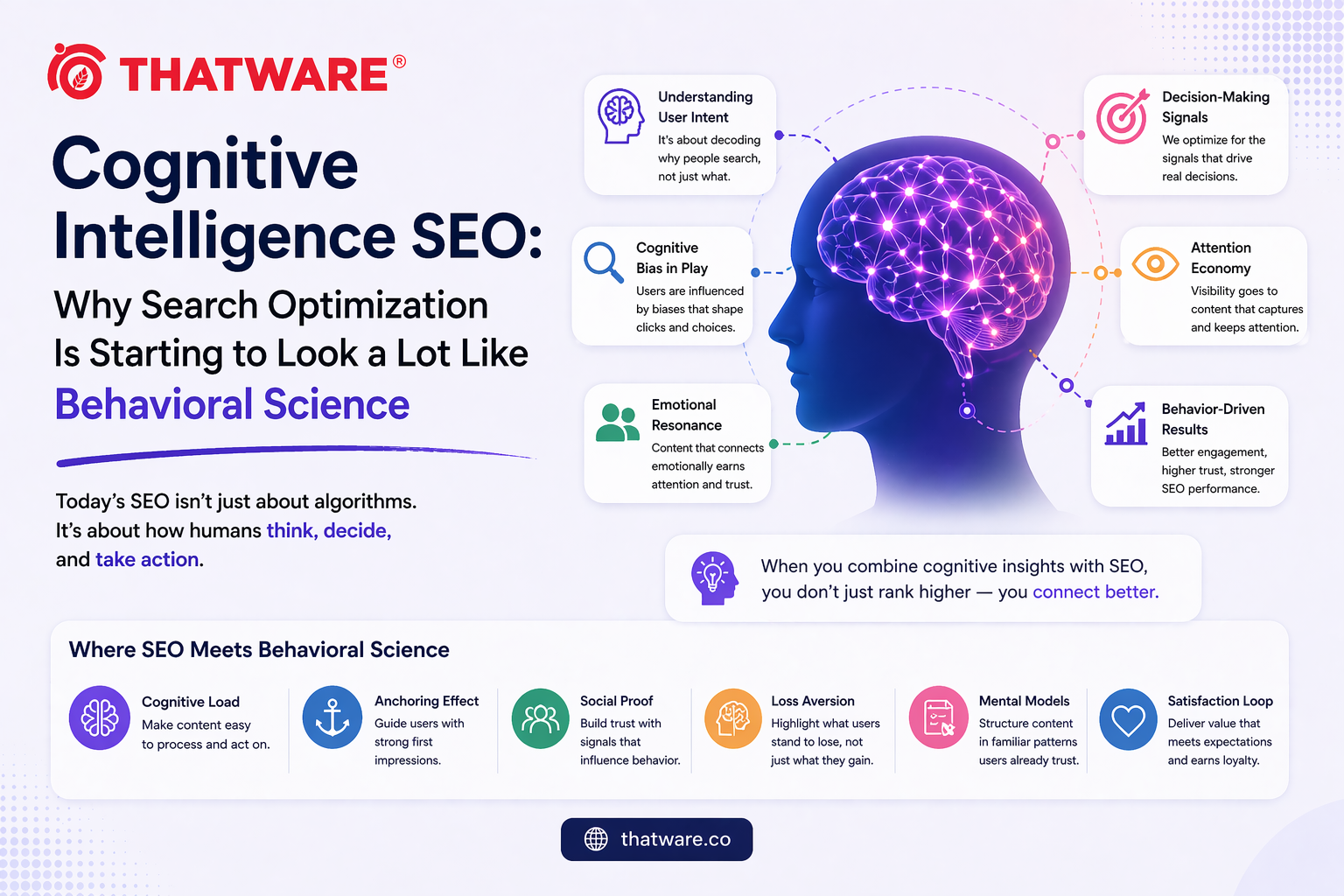
Something has shifted in how the best SEO practitioners think about their work. A few years ago, the dominant mental model was engineering – you were tuning a system, adjusting variables, hitting technical benchmarks. Do the right things in the right order and the rankings would follow.
That model isn’t wrong, exactly. But it’s increasingly incomplete. The more sophisticated the search evaluation systems become, the more SEO starts to look less like systems engineering and more like applied behavioral science.
The Shift in Evaluation Systems
Search engines have always been trying to approximate human judgment – trying to surface content that humans would find valuable, authoritative, and relevant. The difference is that they’re getting much better at it.
Early Google used backlinks as a proxy for authority because human editorial judgment was hard to compute. Modern Google uses machine learning models trained on vast amounts of human engagement data to evaluate quality signals directly. The result is an evaluation system that increasingly captures what actual humans think of content – not just technical signals that were supposed to correlate with human judgment.
That changes what SEO optimization means. If the evaluation system is getting better at modeling human responses to content, then optimizing for the system increasingly means optimizing for human responses. The technical layer and the behavioral layer converge.
What Cognitive Intelligence Adds
Cognitive intelligence, in the context of SEO, refers to understanding how human cognitive processes – attention, memory, decision-making, trust formation – interact with content and search behavior. It’s borrowing from cognitive science to inform how content is created, structured, and positioned.
cognitive intelligence seo services apply this lens at every stage of content strategy. How do users form queries – what’s the cognitive process behind how a question gets phrased? How do they evaluate results on a SERP – what cues trigger a click or a skip? How do they engage with content once they arrive – what determines whether they stay, engage, and convert? And how does their engagement behavior feed back into how search engines evaluate the content?
These are behavioral science questions. They have behavioral science answers. And those answers are increasingly central to what effective SEO requires.
The Intent Model Gets Deeper
SEO has talked about “search intent” for a while – the idea that you should understand what a user is actually trying to accomplish, not just what keywords they typed. But cognitive intelligence approaches push this considerably further.
User intent exists within a broader cognitive context. A person searching for “best project management software” might have the same stated intent as a hundred other searchers, but very different cognitive contexts – different levels of prior knowledge, different emotional states, different stages of the decision process. Content that resonates across those variations performs better than content that optimizes for one assumed context.
cognitive ai seo services use AI-powered behavioral analysis to model these cognitive context variations and create content strategies that address the range of mental states that show up within a given search audience. It’s more complex than traditional keyword-intent matching – but it produces content that performs better across a wider range of users.
Attention as a Design Variable
One of the most interesting things that cognitive science contributes to SEO thinking is the rigorous treatment of attention as a limited and variable resource. Readers don’t arrive at your content with unlimited patience and focus. They have a cognitive budget, and your content either earns more of it or loses it within the first few seconds.
This isn’t new information for web designers. But it has specific implications for SEO content that don’t always get treated seriously. The first paragraph of a piece of content is doing a different job than the middle – it needs to establish relevance and justify continued attention, fast. The structure of a page needs to serve readers who are scanning before they read in full. The density of valuable information per paragraph matters to engagement, and engagement matters to ranking signals.
All of this is cognitive design applied to SEO. It works.
The Research Base
There’s actual research behind this. Studies on reading behavior, attention patterns, trust formation, and decision-making online have produced consistent findings over the last fifteen years. The challenge is that most of this research lives in academic psychology and UX literature, not SEO literature.
Bringing those two bodies of knowledge together is part of what cognitive intelligence SEO is about. The practitioners doing it well are reading both – they understand search systems and they understand human cognitive behavior, and they build strategies that account for both.
What This Looks Like in Practice
Practically, cognitive intelligence SEO shows up in decisions like: how to structure a page header and introduction to minimize cognitive load while establishing relevance quickly. How to choose content formats based on the cognitive mode (scanning vs. deep reading) that a given search audience is likely to be in. How to build trust signals – author expertise indicators, evidence quality, citation patterns – that match how the target audience evaluates credibility.
It also shows what not to do. Aggressive pop-ups that interrupt reading. Dense walls of text that increase cognitive load without increasing information value. Misleading headlines that set up expectations the content doesn’t meet. These behavioral violations cost more than they gain in a world where engagement signals directly influence ranking.
The headline conclusion is simple: the more search engines model human behavior, the more SEO has to account for human behavior. Cognitive intelligence provides the framework for doing that well.