

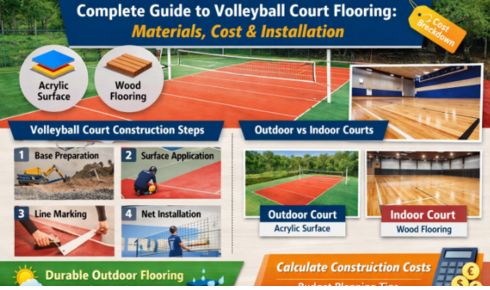
Volleyball is one of the most popular sports played in schools, sports academies, residential complexes, and professional training centers. While players often focus on skills and strategy, the foundation of every great game lies beneath their feet — Volleyball Court Flooring. The right surface directly impacts performance, safety, durability, and long-term maintenance costs.
Whether planning a new facility or upgrading an existing one, understanding Volleyball Court Flooring Material, the process of volleyball court construction, and the overall volleyball court construction cost is essential. This guide explains everything in detail.
Why Volleyball Court Flooring Matters
A volleyball court must provide:
- Proper ball bounce consistency
- Shock absorption to reduce injuries
- Anti-skid surface for quick lateral movements
- Weather resistance (for outdoor courts)
- Long-term durability with minimal maintenance
Poor flooring can result in player fatigue, joint injuries, slippery conditions, and frequent repair expenses. That is why selecting the right Volleyball Court Flooring Material is critical during the planning stage.
Types of Volleyball Court Flooring Material
Different surfaces are used depending on whether the court is indoor or outdoor.
1. Synthetic Acrylic Flooring (Highly Recommended for Outdoor Use)
Synthetic acrylic is one of the most widely preferred options for outdoor volleyball court flooring material. It is applied in multiple layers over a concrete or asphalt base and offers:
- UV resistance
- Slip resistance
- Weather durability
- Customizable colors and line markings
- Low maintenance
Acrylic surfaces perform well in varying climates and maintain surface grip even under intense sun exposure, making them ideal for schools, clubs, and community courts.
2. PU (Polyurethane) Flooring
PU flooring is commonly used for indoor courts. It provides:
- Excellent shock absorption
- Seamless finish
- High player comfort
- Good durability
While slightly more expensive than acrylic systems, PU flooring enhances comfort levels for competitive play.
3. Wooden Flooring (Indoor)
Hardwood flooring is traditionally used for professional indoor volleyball courts. It offers natural ball response and aesthetic appeal. However:
- It requires high maintenance
- Installation costs are higher
- It is sensitive to moisture
Because of maintenance complexity, synthetic systems are often preferred for modern volleyball court construction.
Outdoor Volleyball Court Flooring Material: What Works Best?
For open spaces such as schools, residential societies, and public parks, selecting the right outdoor volleyball court flooring material is crucial.
The ideal outdoor surface must resist:
- Extreme heat
- Heavy rainfall
- Surface cracking
- Color fading
Synthetic acrylic flooring over a properly prepared concrete base remains one of the most practical solutions. It provides durability, weather resistance, and performance stability while keeping maintenance costs manageable.
Step-by-Step Volleyball Court Construction Process
Understanding the volleyball court construction process helps in budgeting and planning timelines effectively.
1. Site Inspection & Planning
The ground is inspected for soil stability, drainage conditions, and space availability. Standard volleyball court dimensions are considered during layout marking.
2. Base Preparation
A strong base is essential for long-term performance. Typically:
- Compacted soil base
- PCC (Plain Cement Concrete) layer
- Reinforced concrete slab
The base must be level and properly cured to prevent future cracks.
3. Surface Layer Application
Depending on the selected Volleyball Court Flooring Material:
- Acrylic coating layers are applied
- Cushion layers may be added for shock absorption
- Anti-skid top coats ensure player safety
4. Line Marking
Professional court marking is done according to official volleyball dimensions and standards.
5. Net Pole Installation
Poles are installed with proper anchoring to ensure stability during gameplay.
The complete volleyball court construction timeline generally ranges between 15–30 days, depending on weather and site conditions.
Volleyball Court Construction Cost Breakdown
The volleyball court construction cost depends on multiple factors:
1. Type of Flooring Material
- Acrylic flooring: Moderate cost, high durability
- PU flooring: Slightly higher cost, premium comfort
- Wooden flooring: High cost, indoor only
2. Base Preparation
Costs vary depending on soil condition and the thickness of the concrete slab required.
3. Location & Labor
Regional labor rates and transportation charges affect the final budget.
4. Additional Features
- Lighting systems
- Fencing
- Drainage system
- Seating areas
On average, outdoor volleyball court construction cost is generally more economical compared to indoor hardwood systems. However, precise budgeting requires site evaluation.
Factors to Consider Before Choosing Volleyball Court Flooring
When selecting Volleyball Court Flooring, consider:
Climate Conditions
Hot and humid climates demand UV-resistant and water-resistant surfaces.
Usage Frequency
High-traffic courts require durable, abrasion-resistant surfaces.
Maintenance Budget
Low-maintenance materials like acrylic coatings reduce long-term expenses.
Safety Requirements
Shock absorption and slip resistance should be prioritized to prevent injuries.
Maintenance Tips for Long-Lasting Volleyball Court Flooring
Proper maintenance extends surface life and reduces repair costs:
- Regular cleaning to remove dust and debris
- Periodic inspection for cracks
- Recoating every few years (for acrylic systems)
- Ensuring proper drainage around the court
Well-maintained surfaces can last 8–12 years or more, depending on material quality and usage intensity.
Indoor vs Outdoor Volleyball Court Flooring
| Feature | Indoor Court | Outdoor Court |
| Surface Type | PU / Wood | Acrylic |
| Weather Resistance | Not Required | Essential |
| Maintenance | Moderate to High | Low to Moderate |
| Installation Cost | Higher | More Budget-Friendly |
For institutions planning multi-sport use, synthetic acrylic systems offer flexibility and cost-efficiency.
Conclusion
Selecting the right Volleyball Court Flooring Material is one of the most important decisions in any sports infrastructure project. From performance and safety to long-term durability and maintenance, every factor must be carefully evaluated.
Understanding the complete volleyball court construction process and estimating the volleyball court construction cost helps avoid budget overruns and technical issues. For outdoor facilities, choosing the correct outdoor volleyball court flooring material ensures long-lasting performance under challenging weather conditions.
A well-constructed volleyball court not only enhances gameplay but also increases the value of sports infrastructure, making it a worthwhile long-term investment.

